
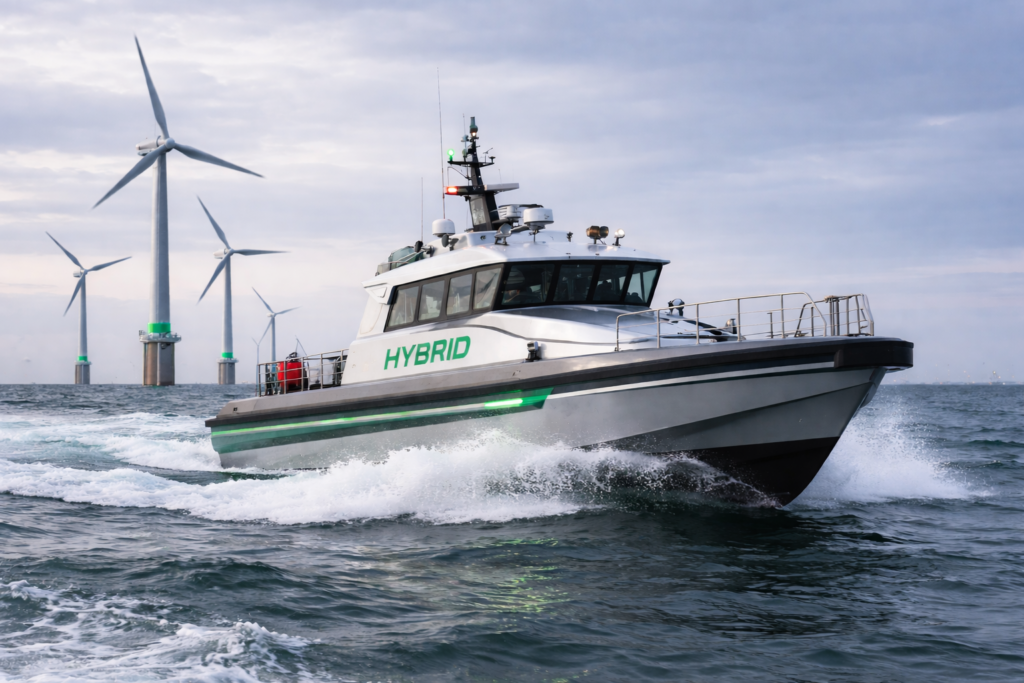
The offshore maritime sector in 2026 is witnessing a seismic shift with hybrid crew boats emerging as the gold standard for crew transfers and logistics support. These vessels integrate diesel-electric engines with high-capacity lithium-sulfur batteries, achieving fuel efficiency gains of up to 45% compared to traditional diesel counterparts. Operating in dynamic positioning mode, they maintain precise station-keeping near wind turbines or oil platforms without thruster overuse, which previously guzzled 20% more fuel. Hull designs incorporating stepped planing surfaces and composite materials reduce hydrodynamic drag by 15%, enabling top speeds of 35 knots even in choppy 2-meter seas. Battery ranges extend to 100 nautical miles on electric-only power, ideal for short-haul runs from shore bases to distant farms. Safety integrations like redundant power grids and automatic load-balancing prevent blackouts during critical transfers. In regions like India’s west coast, where monsoon swells challenge stability, gyroscopic stabilizers synced with AI weather prediction ensure passenger comfort, cutting seasickness incidents by 60%. This tech maturity stems from 2024-2025 pilot programs in the North Sea, where operators like Ørsted logged 10,000+ flawless hours.
Economic and Environmental Impact
Economically, hybrid crew boats deliver ROI within 2.5 years through slashed OPEX—bunker costs drop 35-40%, while maintenance intervals stretch 50% longer due to fewer engine hours. Charter rates reflect this, with premiums of 10-15% over legacy boats offset by availability uptime exceeding 98%. Environmentally, they align with IMO’s interim net-zero guidelines, emitting 70% less NOx and particulate matter in port-adjacent zones. Shore-side megawatt chargers at hubs like Mundra Port enable full recharges in 4 hours, tapping renewable grids. For India’s offshore wind ambitions—targeting 30GW by 2030—these boats support turbine installations by ferrying technicians and tools without fossil fuel dependency. Case studies from European waters show 25% reductions in Scope 1 emissions, bolstering ESG reports for investors. Challenges include initial CAPEX 20% higher, but government incentives like India’s Green Shipping Fund cover 30%, accelerating fleet upgrades. Supply chain localization in Gujarat yards now produces hulls 15% cheaper, fostering job growth in coastal economies.
Future Trajectories and Adoption Barriers
Looking to 2028, autonomy level 3 features—remote oversight with onboard AI decisioning—will handle 40% of routine transits, freeing crews for emergencies. Integration with drone swarms for ahead-scouting further optimizes routes. Barriers persist in extreme climates; cold-weather batteries lose 20% capacity, spurring solid-state R&D. Crew training shifts to simulator-based hybrid ops, mandated by updated STCW codes. Globally, 500+ units are projected by 2027, with Asia-Pacific capturing 40% market share driven by Vietnam and India’s expansions. Operators must navigate certification hurdles from class societies like DNV, emphasizing cyber-secure battery management systems. Ultimately, hybrid crew boats aren’t just vessels; they’re enablers of a decarbonized, resilient offshore ecosystem.